Making and Using Shrub
Shrubs, also called “drinking vinegars,” are an old fashioned (i.e., colonial America!) flavoring used to create sodas and cocktails. There are several methods of production, but common to all is that vinegar is infused with fruit, herbs, and spices over several weeks. Sugar is added at some point in the process to produce a light syrup. At the end, the mix is strained and potentially heated before bottling.
Table of Contents:
Making Shrubs
Fundamentally, shrubs are produced with a simple ratio: one part vinegar to one part sugar by volume. You can also add “to one part fresh fruit” into this ratio, though precision with the fruit isn’t required. A good place to start is 1 pound of chopped fruit, 2 cups of sugar, and 2 cups of vinegar to yield about 3 cups of shrub.
There are several processes for making shrubs:
- Infuse vinegar with fruit, herbs, and spices for several weeks. Strain, then add sugar, potentially heating slightly to dissolve the syrup. Cool, then bottle.
- Macerate fresh fruit, herbs, and spices in sugar. Stir once a day. Continue until the mixture looks juicy, around 2-3 days. Strain the mixture, discard the fruit and spices. Combine syrup with an equal part vinegar.
- Make a simple syrup (equal parts sugar and water) in a saucepan. When the sugar is dissolved, add sliced fruit, spices, and herbs. Bring to a low simmer. Cook until fruit looks tired. Stir in vinegar, bring back to a simmer, then cut the heat. Strain and discard fruit and spices.
- Simmer fresh fruit in seasonings in simple syrup, then add vinegar, strain, and bottle.
Best results come from using ripe fruit, though it doesn’t have to look good. We often eat the best fruit, and reserve the less attractive specimens for shrubs.
Fruit can be peeled, chopped, and/or lightly crushed to improve the infusing process. Shaking the mixture improves extraction and prevents a mother of vinegar from forming.
While the instructions say “discard the fruit and spices,” the remaining solids are still tasty. You can dehydrate the fruit for use in trail mix or granola. You can serve the solids over ice cream or brownies. You can cook it down into a compote. If you’re using particularly strong spices, like juniper berries or black peppercorn, you may want to use an herb sachet to make the secondary use a bit easier.
They should be ripe and sweet, but they do not need to be perfect; this is a great opportunity to use farmers market “seconds” and any fruit that is abundantly in season. Fruit should be thoroughly washed and may be peeled, chopped, or lightly crushed to shorten the infusing process.
Flavor Ideas
Here are some suggested pairings:
- cherry + juniper berries + allspice + red wine vinegar
- cherry + black peppercorn + thyme + red wine vinegar
- red plum + cardamom + brown sugar + plum vinegar
- strawberries + red wine vinegar and a splash of balsamic vinegar
- blueberries + thinly sliced ginger + cider vinegar
- nectarine + peppercorn + brown sugar + white wine vinegar
- peach + cardamom pods + honey + cider vinegar
- pomegranate + peppercorn + white sugar + red wine vinegar
- pear + star anise + brown sugar + white wine vinegar
- fig + peppercorn + red wine vinegar
- rose petal or hibiscus + white wine vinegar
- basil or mint or lemon verbena + white wine vinegar
- ginger + mint + lime juice + cider vinegar
- tomatoes + white wine vinegar + coriander seed + cumin seed + cinnamon + red pepper + Worcestershire
Flavoring ideas to experiment with:
- ginger
- citrus peels
- citrus zest
- rosemary
- bay leaves
- coriander seed
- star anise
- clove
- vanilla
- juniper berry
Granulated white sugar is most commonly used, as that does not dominate the flavor. But you can vary the source of sugar to affect the flavor if desired. Experiment with brown sugar, raw sugar, panela, jaggery, coconut sugar pucks, maple syrup, agave, etc. Honey is also a good option, but being sweeter than sugar, you should aim to use a bit less (3/4 cup honey for every 1 cup sugar)
Any vinegar can be used as long as it is at least 5% acidity. Some homemade vinegars, especially those not starting with a full-strength wine/cider, may not reach this acidity level and thus not provide sufficient preservation potential. Since we run a farm, our main focus is producing shrubs from fruits we grow – cherries, plums, and apples. We also make wine and vinegar from these fruits, so we like to pair the shrub with a vinegar of the same fruit. However, you may be constrained to commonly available vinegars. Here are some flavor notes:
- Distilled white vinegar has a clear, sharp flavor. However, this might be too intensely sharp for your tastes.
- Apple cider vinegar tends to be milder with a more fruity flavor
- Red wine vinegar tends to have a smooth flavor and works well with stronger fruits or dark fruits where color of the final shrub is not so importatn
- White wine vinegar has a smooth, mild flavor and works well with more delicate flavors or where the color of the main ingredient(s) should be allowed to shine through
- Coconut vinegar, if available, is out preferred base for a “generic” vinegar base, with a smooth and mild flavor with a clear body that does not dominate delicate flavors
- Rice vinegar is another good choice for a mild, smooth vinegar base that will not dominate flavors
- Balsamic vinegar is a great addition to add depth to cherries, strawberries, and blueberries, but you only need a splash
Uses
Shrubs are concentrated syrups, so you’ll be consuming it in a small amount – 1-2 tablespoons at a time in most cases, or potentially even less.
- Fill a tall glass with ice, pour in a splash of shrub, and top it off with still or sparkling water, stirring a bit to incorporate the shrub.
- Start with 1 tablespoon and adjust to taste
- Use as a flavoring for a cocktail or apertif (great with gin, whiskey, or vodka)
- Mix with sparkling wine
- Use as a base for marinades
- Drizzle over roasted vegetables or meats
- Use instead of vinegar when making a vinaigrette
- Use as the base for a compote
- Add to iced tea
- Use it to flavor Water Kefir
- Add to finished Kombucha prior to bottling for flavor
Storage
Shrubs keep for a long time by virtue of their main ingredients (vinegar and sugar) and, if used, heat treatment. They will keep at room temperature for long periods of time. However, flavor will degrade over time. 2-3 months seems to be a reasonable consumption window at room temperature for flavor enjoyment purposes. However, we have consumed shrubs after 2 years of pantry storage and still enjoyed the flavor.
In the fridge, shrub will last much longer with peak flavor – 6-8 months at least.
Note that you should not see evidence of fermentation occurring (carbonation, bubbling, hissing when opening). When stored in the pantry, you may see vinegar mothers form, especially using the cold process and raw vinegar. We typically remove these and carry on.
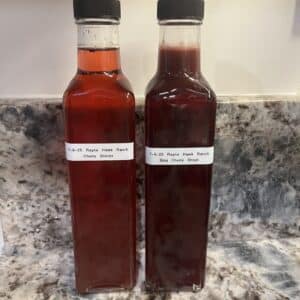
Our Shrubs
-

Cherry Shrub
$12.00
Recipes
- Ginger Mint Shrub, Mastering Fermentation, pg 169
YIELD: About 1½ cups
- ½ cup thinly sliced fresh ginger
- ½ cup packed fresh mint leaves
- ¾ cup raw, unfiltered apple cider vinegar
- ½ cup freshly squeezed lime juice
- ½ cup raw unrefined cane sugar
- Place the ginger and mint leaves in a glass jar; bruise them to release some of the juices. Add the vinegar, close the jar tightly, and shake vigorously for 10 seconds. Replace the lid with cheesecloth. Securely attach a layer of cheesecloth over the opening and leave at room temperature for 12 hours or overnight.
- Replace the cheesecloth with the lid, secure tightly, and repeat the vigorous shaking daily for 1 week.
- Strain out the ginger and mint and stir in the lime juice and sugar until dissolved. Bottle, add a sprig of mint, close tightly, and shake vigorously for 10 seconds.
- Refrigerate for 7 days before using. Give the bottle a vigorous shake every day for that week. Refrigerate after opening. Syrup will last for up to 4 months.
- Cherry Shrub | Nourished Kitchen
- 1 cup sweet cherries (pitted and halved)
- 2 tablespoons fresh thyme leaves
- 1 tablespoon black peppercorns
- 1 cup red wine vinegar
- 1 cup unrefined cane sugar
- Cherry Shrub | The Lemon Apron
Last year I made a Cherry Shrub with black peppercorns. Cherries really lend themselves to more intense, strong spices for depth. Anything less would get lost in the earthy intense sweetness of cherries. This year I decided to try out juniper berries and whole allspice. This would give the final syrup a slightly exotic and savoury touch.
- 2 cups fruit, in this case cherries , cleaned, peeled, seeded, and chopped (if necessary)
- 2 cups vinegar
- 1 tbsp whole juniper berries lightly cracked by pressing on them with the bottom of a jar (but don’t pulverize them)
- 1 tbsp whole allspice lightly cracked by pressing on them with the bottom of a jar (but don’t pulverize them) Can be replaced with black peppercorns
- 1 1/2 to 2 cups sugar